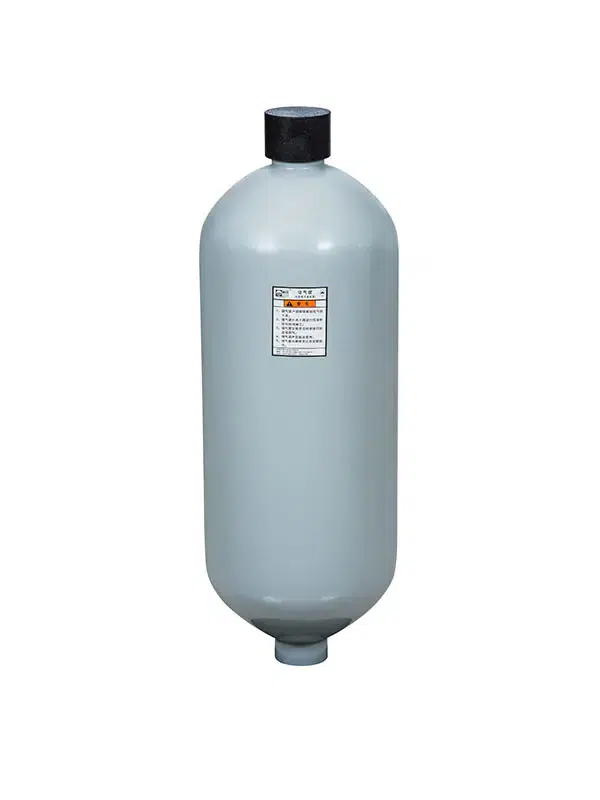
While hydraulic accumulators don’t directly increase the actual flow rate of a pump, they can significantly improve the system’s available flow performance. They work by storing pressurized hydraulic oil when demand is low and releasing it when demand suddenly increases. This allows the system to provide additional flow for a short period without increasing pump size. In practice, this means accumulators can help supplement peak flow demands, making the system respond faster and more efficiently during high-load operation. They also help smooth flow fluctuations, reduce pressure drop, and improve overall system stability.
However, it’s important to note that accumulators are not a continuous source of flow. Once the stored energy is depleted, the system will again rely on the pump.
Key Takeaways
- When the system requires more power, an accumulator can briefly boost flow by releasing stored fluid.
- Pre-charge pressure is crucial. For best results, set it to approximately 90% of the system pressure.
- Select the appropriate accumulator type (bladder, piston, or diaphragm) based on your flow and pressure requirements.
- Regularly check the accumulator’s pre-charge pressure and capacity to ensure proper system operation and prevent flow drops.
- Remember, an accumulator is not a substitute for a pump; it only provides a brief pulse of flow when needed.
How does an accumulator affect flow?
Basic accumulator function
An accumulator is like a special energy storage tank in a hydraulic system. It stores energy by storing pressurized hydraulic oil. When the system needs more power, the accumulator quickly releases the hydraulic oil. This helps the equipment operate more efficiently and smoothly.
Most accumulators consist of three main parts: a housing, an air chamber or spring chamber, and a hydraulic oil interface. A hydraulic pump forces hydraulic oil into the accumulator. The hydraulic oil compresses the internal air chamber or spring, thus storing energy. When the system needs more flow, the accumulator immediately releases the hydraulic oil. This allows for a rapid increase in flow without waiting for the hydraulic pump to operate.
Here is how it works step by step:
- The hydraulic pump makes pressure in the system.
- Fluid goes into the accumulator and squeezes the gas or spring.
- The accumulator holds this energy until your system needs it.
- When you need more, the accumulator sends out fluid, raising flow rate for a short time.
You can use an accumulator to help the pump give more flow when you need a lot for a short time. This makes your system work better, especially when you do not need much fluid all the time.
Flow rate and pressure relationship
In hydraulic systems, both flow rate and pressure are crucial. When using accumulators, it’s essential to understand how they work together. An accumulator only releases fluid when a pressure differential exists. The system must have sufficient pressure to push fluid out of the accumulator when needed.
Using accumulators typically requires increasing system pressure. This ensures the accumulator has enough energy to provide the required flow rate. The pre-charge pressure inside the accumulator is also important. If the pre-charge pressure is too low, the accumulator cannot provide sufficient flow. If the pre-charge pressure is too high, the accumulator may not be able to draw enough fluid from the pump.
The size of the accumulator determines how much fluid it can store and release. A larger accumulator means more energy and can provide a greater flow boost when needed. Pre-charge pressure, size, and system pressure together control how the accumulator changes flow rate.
The rate at which the accumulator charges and discharges fluid depends on the size of the fluid interface, the pressure differential, and the type of gas used for pre-charge. This means the system response speed will vary depending on these factors. Choosing the right accumulator can result in faster response and smoother operation.
Studies have shown that altering the precharge amount and size of accumulators can improve system performance. For example, in large trucks, a suitable accumulator can improve system response and reduce fuel consumption. Manufacturers design accumulators considering how to deliver peak flow, maintain pressure stability, and protect critical system components.
Tip: Always check the accumulator’s precharge amount and size to ensure it matches the system’s flow and pressure requirements. This helps achieve optimal performance and ensures equipment safety.
Hydraulic accumulators are crucial in today’s systems. They contribute to energy savings, maintain pressure stability, and ensure smooth system operation.
When can an accumulator increase flow?
Temporary flow boost scenarios
Sometimes your hydraulic system needs more flow than the pump gives. This can happen when you start a big machine or lift something heavy. The accumulator helps during these times. It stores energy as pressurized fluid and lets it out fast when needed. This gives your system a quick burst of higher flow.
If the pump cannot keep up, the accumulator helps right away. It sends out stored fluid quickly, so your equipment does not slow down. You see this in machines that move fast or handle shocks. The accumulator acts like a helper until the pump catches up. This keeps your system working smoothly and stops pressure from dropping.
The accumulator also helps when the pump starts or stops. Sometimes there is a delay when the pump turns on or off. The accumulator fills in this gap by giving fluid right away. Your system keeps steady flow and pressure, even for a short time. This means your pump does not wear out as fast.
Note: Hydraulic accumulators can also make your system quieter. They take in shocks and smooth out pressure changes. This makes your equipment safer and more reliable.
Limitations of accumulator flow increase
An accumulator cannot give extra flow all the time. The boost only lasts while there is enough stored fluid. The size of the accumulator decides how much extra flow you get and for how long. When the stored fluid runs out, the accumulator must refill before helping again.
Pre-charge pressure is also important. If you set it too high, the accumulator cannot take in enough fluid. If you set it too low, it cannot push out enough fluid when needed. You should set pre-charge at about 90% of your system pressure. This keeps enough oil and gas space for good pressure control. You get fewer pressure spikes and smoother flow.
Here is how stored volume and pre-charge pressure limit flow:
- The right pre-charge lets the accumulator store enough fluid.
- The size of the accumulator sets the most fluid it can give.
- If system pressure drops below pre-charge, the accumulator stops giving fluid.
You should also consider the ratio of maximum pressure to precharge pressure. Keeping the maximum pressure within three times the precharge pressure helps extend the life of the bladder accumulator. This means your accumulator will work more efficiently and require less maintenance. The system design determines the auxiliary role the accumulator provides. You cannot replace a pump with an accumulator. It can only provide a short-term flow boost. To achieve a stable flow, you still need a sufficiently powerful pump. Accumulators are best suited as auxiliary devices in rapidly changing or sudden situations.
Tip: Always match the accumulator size and precharge pressure to your system. This helps your hydraulic system perform at its best and ensures its safety.
Hydraulic accumulators are a wise choice for handling peak demands and protecting equipment. You can achieve better performance, but only if you understand the limits of flow and pressure.
Types of hydraulic accumulators and their flow roles
Bladder, piston, and diaphragm accumulators
There are three main types of accumulator in most hydraulic systems. These are bladder, piston, and diaphragm. Each one has a special design and job for flow and pressure.
Here is a simple table to compare these types:
| Type of Accumulator | Key Features | Best Applications |
|---|---|---|
| Bladder | Good for shock absorption and energy storage in a compact form | Applications requiring energy storage and shock absorption |
| Piston | Handles high pressures, provides consistent flow rate | Applications needing precise control of fluid flow |
| Diaphragm | Balances energy storage and flow consistency | General applications requiring both features |
- Bladder accumulators are best for fast action and shock absorption. You see them in machines that need quick flow or must handle shaking.
- Piston accumulators give steady flow and work with high pressure. You use them when you want exact control and need to store more fluid.
- Diaphragm accumulators balance energy storage and flow. They fit in small spaces and work in many hydraulic systems.
Ningbo Chaori Hydraulic sells all three types. You can pick the right accumulator for your system by looking at flow needs, pressure, and space.
Tip: Bladder and diaphragm accumulators react fast and keep out dirt. This makes them good for quick flow.
High vs. low pressure hydraulic accumulator
You will also need to choose between high-pressure and low-pressure accumulators. Each type of accumulator works differently in terms of flow and pressure.
High-pressure accumulators store more energy in a smaller space. They are suitable for rapid, strong flow rates or for maintaining stable pressure when the system is unstable. Low-pressure accumulators help smooth out small pressure changes and increase flow rate for short periods. They are suitable for systems that require faster circulation or to cope with temperature changes.
You need to check the pre-charge pressure and size of both types of accumulators. A proper pre-charge pressure helps the accumulator achieve optimal flow and ensures system safety. Regularly check the nitrogen pressure and observe the accumulator to ensure it is functioning correctly.
Note: Temperature changes can affect the pressure inside the accumulator. Always choose the appropriate size to maintain stable flow.
Ningbo Chaori Hydraulics offers a wide variety of hydraulic accumulators; you can find the type and pressure best suited to your flow and pressure needs.
Practical tips for using hydraulic accumulators
Real-world expectations for flow
When using an accumulator, it is essential to understand its function. An accumulator provides a rapid flow boost when most needed. This occurs when the system’s required flow exceeds the pump’s supply capacity. However, the accumulator does not provide extra flow indefinitely. This boosting effect only lasts when there is sufficient fluid in the accumulator. Afterward, the pump must be refilled with fluid to continue providing boost.
To ensure proper system operation, check the precharge pressure frequently. A proper precharge pressure allows the accumulator to store and release fluid at the appropriate pressure. Optimal flow will not be achieved if the precharge pressure is too high or too low. Setting the correct precharge pressure helps the system operate smoothly and ensures equipment safety.
Tip: Always ensure that the accumulator’s capacity matches the system’s flow and pressure requirements. This helps prevent slow system operation and ensures proper machine function.
Choosing the right accumulator
You need to pick the best accumulator for your job. Here are the main things to think about:
- Energy storage capacity: Make sure the accumulator can hold enough energy for your system’s flow and pressure.
- Type of accumulator: Pick the type that fits your job and the fluid you use.
- Operating pressure: Choose an accumulator with a pressure rating that matches your system.
- Fluid compatibility: Check that the accumulator works with your fluid and the right temperature.
- Size and weight: Think about how much space and weight your system can handle.
- Installation and maintenance: Look at how easy it is to put in and take care of the accumulator.
- Environmental factors: Think about temperature, humidity, and if there are any harmful materials nearby.
Safety and reliability are very important. Look for accumulators with the right certifications. These show the accumulator meets safety rules and works well in important places. Here is a table that shows how safety ratings help you choose:
| SIL Rating | Description | Application |
|---|---|---|
| SIL 1 | Low safety integrity | General applications |
| SIL 2 | Moderate safety integrity | Well shutdown valves |
| SIL 3 | High safety integrity | High-risk emergency systems |
Cost matters too. You should compare the price, how much it costs to use, and how long it will last. Some companies let you pay over time to help with money.
If you follow these tips, you can pick an accumulator that gives the right flow, pressure, and capacity for your needs. You also make your system safer and more reliable.
As you already know, accumulators can quickly increase flow rate, but they cannot maintain a high flow rate indefinitely. You need to set the precharge pressure correctly and select the most suitable accumulator type for your application. Some people make mistakes regarding precharge pressure.
To fully utilize the performance of your hydraulic accumulator, consult an expert. They can help you match the pressure, volume, and flow rate of your system. They will help you select the appropriate model to ensure your system operates safely and efficiently.
FAQ
What does an accumulator do in a hydraulic system?
An accumulator stores fluid under pressure. It lets out this fluid fast when your system needs more power. This helps your equipment run smoothly. It also protects your equipment from quick pressure changes.
Can an accumulator replace a hydraulic pump?
You cannot use an accumulator instead of a pump. The pump gives steady flow all the time. The accumulator only gives extra flow for a short time when needed.
How do I know if my accumulator needs maintenance?
You should look for slow system response or pressure drops. You should also check for leaks. If you see these signs, check the accumulator and follow the maintenance guide.
What happens if I set the pre-charge pressure wrong?
If the pre-charge is too high or too low, your system may not work right. You might see pressure spikes or slow movement. Your equipment could even get damaged.
How often should I check the pre-charge pressure?
You should check the pre-charge pressure often, at least every few months. This keeps your system safe and working well.