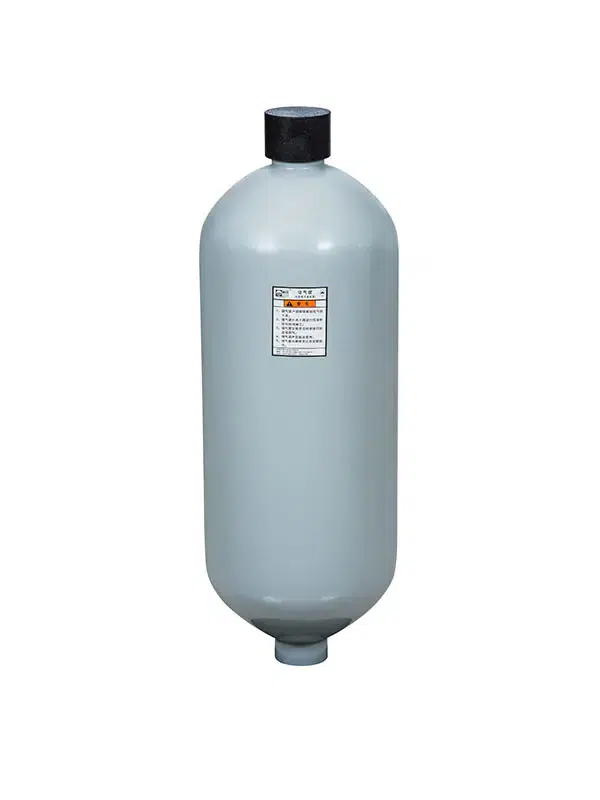
Sizing a hydraulic accumulator correctly depends on the fluid volume the system requires between its minimum and maximum operating pressures. The basic calculation formula is:
V_acc = V_fluid / [(P0 / P1)^(1/n) – (P0 / P2)^(1/n)]
Here, V_fluid is the volume of fluid the system needs to supply or absorb, P0 is the pre-charge pressure, P1 is the minimum operating pressure, P2 is the maximum operating pressure, and n is the gas exponent. When performing the calculation, gauge pressures must be converted to absolute pressures by adding atmospheric pressure. The value of the gas exponent depends on the system’s operating speed: n = 1 for isothermal conditions and n = 1.4 for adiabatic conditions. This guide covers the calculation method, key inputs, and how to refine your result with temperature, accumulator type, and safety margins.
Key Takeaways
- Use absolute pressures and the main accumulator sizing formula to calculate the gas volume, not the oil volume.
- Match the gas exponent to the cycle speed: use 1.4 for fast cycles, 1.2 for medium cycles, and 1.0 for slow cycles.
- Add a 10–20% safety margin. Check your final size with the maker’s sizing tools.
Calculate Required Accumulator Volume

Define Fluid Demand and Pressure Range
First, determine the effective oil volume that the accumulator must supply or absorb during the operating cycle. This value represents not the total volume of the accumulator, but rather the volume of fluid discharged and returned within a single cycle. This figure can be directly derived for presses where a cylinder is driven through a known stroke volume; similarly, it can be readily determined for pump systems requiring a specific volume to dampen pulsations.
The second key parameter is the pressure range (or pressure window). The volume of fluid stored by the accumulator corresponds to the difference between the gas volumes at the minimum and maximum operating pressures. If the pressure range is narrow, a larger gas volume is required to meet the same fluid demand. When sizing an accumulator, a minimum pressure of 1,000 psi and a maximum of 3,000 psi are typically used as a starting point; most industrial accumulators operate at pressures below 3,000 psi.
Apply Boyle’s Law With the Correct Gas Exponent
Boyle’s Law describes the relationship between pressure and volume as a gas transitions between two states. The basic formula provided in the Hydroll guidelines is: V0 = V1 x (P1 / P0)^(1/n). In this formula, V0 is the required gas volume, V1 is the required fluid volume, P0 is the absolute pre-charge pressure, P1 is the absolute minimum pressure, and n is the gas compression exponent. Incorporating the maximum pressure P2 yields the complete equation: V_acc = V_fluid / [(P0 / P1)^(1/n) – (P0 / P2)^(1/n)].
The Hydroll guidelines use the equation V0 = V1 x (P1 / P0)^(1/n) as the basis for calculating accumulator size. Here, V0 represents the required gas volume, V1 the required fluid volume, P0 the absolute pre-charge pressure, P1 the absolute minimum pressure, and n the gas compression exponent. The value of this exponent is 1.0 for isothermal processes and 1.4 for adiabatic processes.
The value of the exponent n depends on the cycle speed. If the discharge process is completed within one minute, it is treated as an adiabatic process (n = 1.4); if the cycle takes longer than three minutes, it is treated as an isothermal process (n = 1.0); and if the duration is between one and three minutes, n is set to 1.2. Compared to isothermal estimates, the usable fluid volume under adiabatic expansion conditions is approximately 15%–25% lower. Consequently, systems with high cycle speeds require shells with larger capacities.
| Cycle duration | Exponent n | Process |
|---|---|---|
| Under 1 minute | 1.4 | Adiabatic |
| 1–3 minutes | 1.2 | Compromise |
| Over 3 minutes | 1.0 | Isothermal |
Use absolute pressure for all sizing calculations. Gauge pressure leaves out the atmosphere, and that changes the ratio between the starting and ending gas pressures. At sea level, add 14.7 psi before you solve.
Key Inputs for Sizing Hydraulic Accumulators

Set Precharge, Minimum, and Maximum Pressures Correctly
Pre-charge pressure is the nitrogen charge pressure set before system operation. This value must be lower than the system’s minimum operating pressure. Maintaining this pressure differential ensures that a certain amount of fluid always remains within the accumulator. If the bladder empties completely, it could be forced into the anti-extrusion device and rupture. For bladder accumulators, the pre-charge pressure is typically set at 80% of the system’s minimum pressure. For piston accumulators, the pre-charge pressure should also be set below the system’s minimum pressure. When the accumulator is used as a shock absorber or pulsation dampener, the pre-charge pressure should likewise be kept below the system’s minimum pressure. Generally, pre-charge pressure should be set between 80% and 90% of the system’s minimum pressure, and the system’s maximum pressure should not exceed approximately four times the pre-charge pressure.
When performing sizing calculations, it is essential to use absolute pressure. Gauge pressure does not include atmospheric pressure, which alters the ratio between the initial and final gas pressures. At sea level, atmospheric pressure is approximately 14.7 psi; this value should be added to each gauge pressure reading before calculations are made. Taking minimum and maximum gauge pressures of 1500 psi and 3000 psi as examples, even slight variations in these figures can alter the required accumulator volume; therefore, this step must not be overlooked.
| Parameter | Meaning | Example Value |
|---|---|---|
| P1 | Gas charge pressure | 80–90% of minimum operating pressure |
| P2 | Maximum operating pressure | 3000 PSI |
| P3 | Minimum operating pressure | 1500 PSI |
| Vx | Required fluid volume | 1.5 gallons |
| n | Gas expansion factor | 1 or 1.4 |
Correct for Temperature and Duty Cycle Effects
Temperature affects the gas charge state. If the operating temperature differs from the pre-charge temperature, the pre-charge pressure will change accordingly. Please use the combined gas law based on absolute temperature: P1 / T1 = P2 / T2. Before applying this ratio formula, temperature readings in Fahrenheit or Celsius must be converted to absolute temperature. After adjusting the pre-charge pressure, the required accumulator volume should be recalculated. Bladder materials also have temperature limitations; for temperature limits regarding Buna-Nitrile and FKM (fluoroelastomer), please refer to the technical data provided by the elastomer supplier.
The operating cycle determines the gas exponent (n-value). Slow cycles exceeding three minutes allow heat exchange to occur, meaning the process is treated as isothermal (n = 1); conversely, rapid cycles lasting less than one minute do not allow sufficient time for heat transfer, so the process is treated as adiabatic (n = 1.4). Adiabatic expansion causes the nitrogen to cool and results in a greater pressure drop than estimated under isothermal conditions; this discrepancy implies that a larger accumulator volume is required. Use n = 1.4 for energy storage, shock absorption, or emergency power applications, and use n = 1.0 for volume or leakage compensation applications. Selecting the incorrect exponent will result in insufficient accumulator capacity, thereby compromising system performance.
Improve Your Accumulator Sizing by Type and Safety
Compare Bladder, Piston, and Diaphragm Hydraulic Accumulators
Each accumulator type changes the final size you need. A bladder accumulator reacts quickly to pressure changes and fits in small spaces. It works well for high-pressure energy storage and shock absorption. A piston accumulator handles large flow rates and high pressure. Seal friction can slow its response, and it needs extra room for dead volume. A diaphragm accumulator works for small systems that need exact pressure control.
| Type | Response time | Pressure ratio |
|---|---|---|
| Bladder | Fast | About 4:1 |
| Piston | Slower | About 4:1 |
| Diaphragm | Very fast | About 4:1 |
Add Efficiency and Safety Factors to Avoid Sizing Mistakes
Selecting an accumulator that is too small results in insufficient energy storage, while one that is too large slows down response times. After performing the initial sizing calculations, apply the appropriate efficiency factor for the chosen type and verify the results using the manufacturer’s sizing tools and technical support.
Incorporate a safety margin of 10%–20% into the calculated size to account for gas loss, temperature fluctuations, and long-term wear, then select the nearest standard specification. Note that low-temperature environments can reduce the effective fluid volume. The pre-charge pressure should be set to 80%–90% of the system’s minimum pressure; incorrect pre-charge settings can lead to accumulator failure. Following these steps ensures appropriate accumulator selection for handling actual operating pressure fluctuations.
The core of accumulator selection lies in determining the gas volume—rather than the fluid volume—and then converting this into the required accumulator specification. Key parameters include fluid volume, absolute pre-charge pressure, minimum and maximum pressures, the gas exponent, temperature, and accumulator type. Using absolute pressure and the correct exponent ensures calculation accuracy. Always cross-check results against the manufacturer’s tools and apply efficiency factors and safety margins based on actual pressure variations.
FAQ
What happens if the precharge pressure is too high?
If the pre-charge pressure is too high, the space available for fluid becomes very limited. In this case, the bladder or piston reaches its limit position, rendering the accumulator virtually unable to store fluid. For bladder-type accumulators, it is recommended to set the pre-charge pressure to approximately 80% of the minimum operating pressure.
Can a person size an accumulator without the gas exponent?
No. The exponent is critical. Rapid cycling requires n = 1.4, whereas slow cycling requires n = 1.0. Incorrect setting of this value results in an undersized unit, thereby compromising performance.
Does temperature change the required accumulator size?
Yes, gas pressure varies with temperature. Absolute temperature should be used when setting the pre-charge pressure, followed by a recalculation. Cold weather may reduce the effective fluid volume.