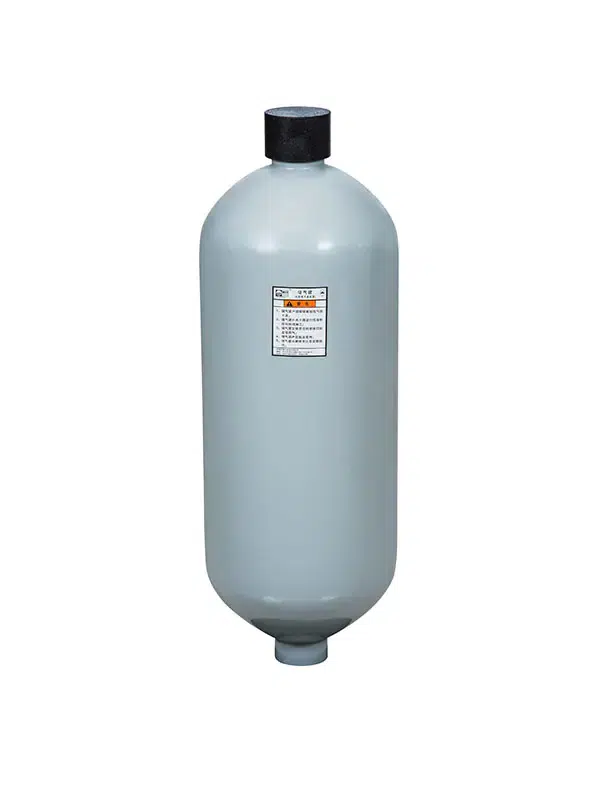
Industry uses three types of accumulators: bladder, diaphragm, and piston. Bladder and diaphragm accumulators use a flexible separator, while piston accumulators rely on a solid barrier. Each hydraulic accumulator stores energy and reduces pressure spikes in hydraulic systems. The market reached US$4.92 billion in 2025. This article covers how they work, their performance, application fit, and selection criteria.
Key Takeaways
- Industry uses three main kinds of accumulators: bladder, diaphragm, and piston.
- Bladder and diaphragm accumulators respond quickly and suit high-cycle applications.
- Piston accumulators excel under high pressure and hold large fluid volumes for heavy-duty jobs.
Main types of accumulators in industry

Bladder, diaphragm, and piston accumulators are the three most common types in industry. Each design separates gas and fluid in its own way, and that difference shapes performance.
Bladder hydraulic accumulator
A bladder hydraulic accumulator holds a nitrogen pre-charge inside an expandable rubber bladder mounted within a steel shell. Hydraulic fluid fills the space around the bladder. As circuit pressure rises, the fluid compresses the gas, storing hydraulic energy. When pressure drops, the gas expands and pushes the stored fluid back into the line.
This design reacts quickly to pressure changes and performs well in high-pressure service. The bladder provides complete separation between gas and fluid, keeping contamination out of the gas side. Maintenance focuses on bladder replacement and checking the gas pre-charge pressure. Technicians can often replace the bladder without removing the shell from the circuit.
Bladder accumulators suit a wide range of duty cycles. Common applications include:
- Hydraulic presses and forming machines that need steady force and shock absorption
- Injection molding machines that require consistent cycles and reduced hydraulic noise
- Wind turbines and automation systems operating under changing conditions
- Mining and heavy machinery that store emergency energy and handle varying loads
- Marine and offshore equipment that demands stability in rough environments
For a full range of bladder options, see bladder accumulators.
Diaphragm hydraulic accumulator
A diaphragm accumulator uses a flexible rubber diaphragm, welded or clamped between two body halves, to separate the gas chamber from the fluid chamber. During operation, oil enters and pushes the diaphragm toward the gas side, compressing the nitrogen. When the system needs fluid, the gas pushes the diaphragm back and discharges oil while keeping gas and fluid fully apart.
The working cycle follows a fixed sequence: gas pre-charge, fluid entry, diaphragm compression, energy storage, and fluid release. The one-piece diaphragm lowers failure risk and supports long cycle life, which benefits systems with frequent pressure changes.
Diaphragm units are the most compact of the three main types. They respond fast, have few moving parts, and handle frequent cycling. Nominal volumes range from 0.075 L to 3.5 L, with pressure ratings from 100 to 330 bar. Smaller sizes (0.075–0.75 L) use an 8:1 compression ratio; larger sizes (1.0–3.5 L) use 4:1. Typical applications include light equipment, automotive brake systems, lubrication systems, and small mobile machinery, often below 3,000 PSI. For details, visit diaphragm accumulators.
For completeness, metal bellows accumulators also exist. Accumulators can also be grouped by loading method as weight-loaded, spring-loaded, and gas-loaded, with gas-loaded being the most common.
Comparing types of hydraulic accumulators

Performance and application fit
Pressure capacity and response time are the clearest differences among the three designs. The table below summarizes the key differences.
| Type | Pressure capacity | Response time |
|---|---|---|
| Piston | Highest ratings; often above 700 bar | Slower due to piston inertia |
| Bladder | Lower maximum, limited by bladder material | Fast, responds in milliseconds |
| Diaphragm | Limited range; not for high-pressure systems | Very fast, almost instant |
In applications such as servo systems, accumulator response time is critical. When the required response time is less than 25 msec, a bladder or diaphragm accumulator should be used.
Flow and volume follow the same pattern. Piston accumulator flow rates usually exceed bladder designs, and one piston accumulator can hold up to 200 gal in a single vessel. Bladder units stop at 40 gal, with standard sizes capped at 220 gpm. A high-flow port raises that to 600 gpm. Flows above 600 gpm require multiple accumulators on a common manifold. Piston speed should stay under 10 ft/sec to prevent seal damage. For piston options, see piston accumulators.
Each hydraulic accumulator type stores energy through compressed gas. The gas reacts to hydraulic pressure changes, and the separator shape determines how fast that reaction occurs. A bladder or diaphragm moves with little mass and reacts quickly. A piston accumulator carries more mass and lags slightly at very low flow rates. That gap is negligible in most industrial applications.
Application fit follows these traits. Bladder accumulators work well for high-frequency jobs in construction equipment, wind power systems, and industrial machinery. Piston accumulators fit large-volume storage in steel plants and heavy industry. Diaphragm accumulators serve low-pressure duties in mobile equipment and small machinery. These uses overlap, so the duty cycle makes the call.
How to select and maintain
Selection begins with required volume, pressure rating, response speed, fluid compatibility, space, and cost. A safety factor of 1.1–1.2 on calculated volume is common, and a typical nitrogen pre-charge sits near 0.9 times minimum system pressure. Standards matter: ASME requires a 4:1 burst-to-rated ratio, PED requires 2.8:1 and a CE mark above 1 liter, and both expect an ISO 9001 quality system. Temperature range, humidity, and corrosive exposure may call for special coatings or materials.
Maintenance differs by design. Bladder and diaphragm units need periodic bladder or diaphragm replacement and gas pre-charge checks. Piston accumulators need seal inspection and nitrogen charge verification. Replacement intervals depend on cycle rate and fluid cleanliness. Technicians check the accumulator charge before startup and after any repair. Chaori Hydraulic manufactures bladder, piston, and diaphragm accumulators, integrated stations, and accessories such as charging tools and safety valve blocks. Explore the full accumulator range or learn about accumulator stations for system integration.
Bladder accumulators have a flexible bladder that reacts fast at high pressure. Diaphragm accumulators use a welded diaphragm for compact, low-volume jobs. Piston accumulators have a solid barrier for large-volume, heavy-duty storage. Bladder units work well for wind power and construction. Diaphragm units fit farm and offshore equipment, and piston units serve steel plants. When choosing, consider system volume, pressure, response, and cost. There is no single best choice.
FAQ
Which type handles the highest pressure?
Piston accumulators reach the highest ratings, often above 700 bar. Bladder and diaphragm designs top out lower because their flexible separators limit the ceiling.
How often should someone check the gas precharge?
Technicians check the charge before startup and after any repair. A typical nitrogen charge sits near 0.9 times minimum system pressure. Cycle rate and fluid cleanliness determine the replacement interval.
Does one accumulator type fit every system?
No. Servo systems requiring response under 25 msec call for a bladder or diaphragm unit. Large-volume storage favors a piston accumulator. The three types of hydraulic accumulators each serve different duties.