
An electric vehicle (EV) battery is a rechargeable energy storage system that powers the vehicle’s electric motor. Most EVs use lithium-ion battery packs. These packs store electrical energy and release it as needed; this directly affects driving range, performance, and safety. According to EV Database, the average usable battery capacity of a battery electric vehicle (BEV) is 73.5 kWh. Engineers design batteries around the motor and controller requirements. For specific capacity or voltage needs, customized battery solutions are often ideal.
Key Takeaways
- An EV battery is a rechargeable pack that stores and releases energy to power the motor.
- EV batteries use lithium-ion cells and a battery management system (BMS) to monitor safety, performance, and lifespan.
- EV batteries differ from conventional automotive batteries in voltage, chemistry, and application.
- Thermal management and safety features are critical to performance and longevity.
- Buyers should choose reputable manufacturers with strong R&D, after-sales service, and clear warranties.
What Is an EV Accumulator?
An EV battery pack stores and discharges electrical energy to power the motor. Think of it like a water tank: capacity determines range, power output determines acceleration, and thermal management keeps it safe. Inside, lithium-ion cells store chemical potential energy. During charging, electrons move from the cathode to the anode; during discharge, they move back, converting chemical energy into electricity. Each cell has a cathode, anode, separator, and electrolyte.
Unlike a regular 12V lead-acid car battery—which starts the engine and powers accessories—an EV traction battery is a high-voltage lithium-ion pack (typically 200–800V) with a BMS, cooling components, and a protective housing. It powers the electric motor and recharges via an external charger or regenerative braking. EV packs typically last 8–15 years and store 30–100+ kWh, compared with 0.5–1 kWh for regular batteries.
A real-world example: a 2023 Tesla Model 3 Long Range owner in Norway reported that after 80,000 km over three years, the battery still retained approximately 93% of its original capacity. This aligns with data from Geotab’s fleet analysis, which found an average annual degradation rate of about 1.8% across 6,000 EVs.
How Does an EV Accumulator Work?
Energy Storage and Release
EV batteries undergo routine charge-discharge cycles. Lithium-ion chemistry determines specific energy and range. LFP cells offer safety, long cycle life, and low cost—typically 90–160 Wh/kg specific energy and 3,000–5,000 charge cycles. NMC and NCA cells provide higher energy density (150–260 Wh/kg) but cost more and have shorter lifespans (1,000–2,000 cycles). LTO cells charge quickly but store less energy (50–80 Wh/kg). Engineers choose chemistry based on range, cost, safety, and charging speed. Data sources include BloombergNEF and IEA battery reports.
Cells, BMS, and Housing
Cells come in pouch, prismatic, or cylindrical formats. The BMS monitors voltage, current, and temperature; it prevents overcharging, balances cells, and disconnects the circuit if needed. The housing protects against impact, moisture, and thermal stress. Safety standards such as IEC 62133, UN 38.3, and UL 2054 govern design and testing. UN 38.3, for example, requires passing eight tests including altitude simulation, thermal cycling, vibration, shock, and short circuit—ensuring safe transport.
The Role and Benefits of EV Accumulators in Electric Vehicles
Energy Storage and Performance
Battery capacity (kWh) determines range. Larger packs store more energy but add weight—a 40 kWh pack weighs about 300–400 kg, while a 100 kWh pack can exceed 600 kg. Mass-market EVs use 400V systems; high-performance EVs use 800V platforms; heavy-duty vehicles are moving toward 1000V+. Higher voltage reduces current, enabling faster charging and lighter cables. For reference, a 400V system charging at 150 kW draws about 375A, while an 800V system at the same power draws only 187A—cutting resistive losses by roughly 75%.
Safety, Efficiency, and Longevity
The BMS and thermal management keep cells within safe temperature ranges. Cold weather reduces capacity: at -20°C, a typical EV battery retains 60–70% of room-temperature capacity; at -40°C, only 40–50%. This data comes from AAA and ADAC winter testing reports. Battery lifespan is typically 15–20 years or up to 300,000 miles, with about 1.8% annual capacity degradation, according to Geotab’s 2023 analysis. Manufacturers often guarantee at least 70% capacity for 8–10 years or 100,000 miles.
Hydraulic vs. EV Accumulators

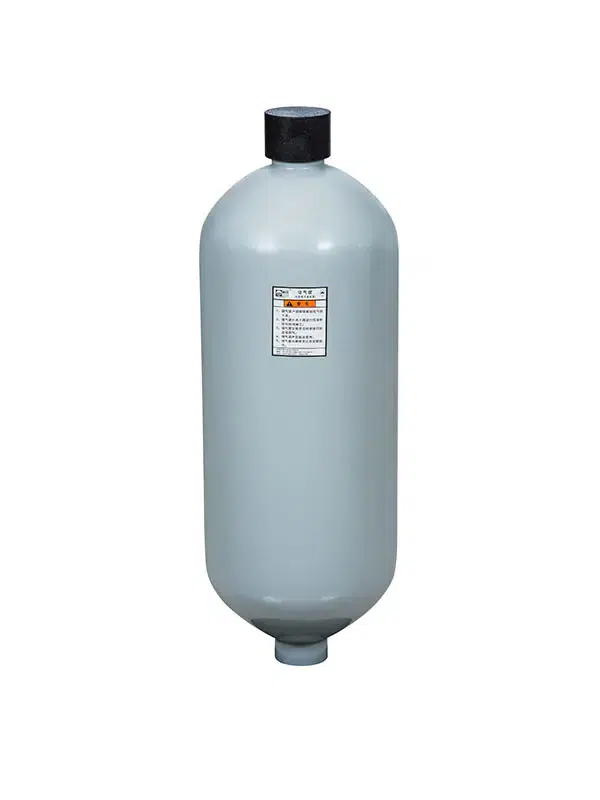
Both store and release energy, but use different media. Hydraulic accumulators store potential energy in pressurized fluid for industrial machinery, while EV accumulators store chemical energy in lithium-ion cells for electric propulsion. Common hydraulic types include the bladder accumulator and piston accumulator. Hydraulic accumulators are used in manufacturing, injection molding, and metal forming; EV accumulators power electric vehicles, portable electronics, and grid storage.
Key differences: hydraulic accumulators offer high power density and millisecond response times but low energy density (0.5–2 Wh/kg). EV batteries offer high energy density (150–250 Wh/kg) but lower power density and slower response. Both technologies serve different roles—hydraulics excel at short, high-power bursts, while batteries excel at sustained energy delivery.
Sourcing Quality Accumulators
For hydraulic accumulators, buyers should seek qualified manufacturers with strong R&D, after-sales support, and clear warranties. Supply chain stability is also critical. For EV batteries, the same principles apply: verify production capacity and secure alternative suppliers.
In short, an EV accumulator is a rechargeable lithium-ion system that stores energy, powers the motor, and manages safety and performance. A hydraulic accumulator stores pressurized fluid for industrial use. Both types are essential in their respective fields.
FAQ
How long does an EV accumulator last?
Most EV batteries last 8–15 years. Manufacturers typically guarantee at least 70% capacity for 8–10 years or 100,000 miles. Annual degradation is about 1.8%, according to Geotab’s 2023 fleet analysis. However, degradation varies by climate, charging habits, and battery chemistry. LFP batteries tend to degrade slower than NMC in high-temperature environments.
What voltage does an EV accumulator use?
Mass-market EVs use 400V; high-performance models use 800V; heavy-duty vehicles move toward 1000V+. Voltage depends on the motor and controller. Real-world examples: Tesla Model 3 uses 400V, Hyundai Ioniq 5 uses 800V, and the Tesla Cybertruck uses 800V. Higher voltage enables faster charging by reducing current for the same power.
Can a regular car battery replace an EV accumulator?
Mass-market EVs use 400V; high-performance models use 800V; heavy-duty vehicles move toward 1000V+. Voltage depends on the motor and controller. Real-world examples: Tesla Model 3 uses 400V, Hyundai Ioniq 5 uses 800V, and the Tesla Cybertruck uses 800V. Higher voltage enables faster charging by reducing current for the same power.
Is an EV accumulator the same as a hydraulic accumulator?
No. EV accumulators store chemical energy in lithium-ion cells. Hydraulic accumulators store pressurized fluid for industrial machinery. While both buffer energy, their operating principles, energy densities, and applications differ fundamentally. Hydraulic accumulators are governed by ISO 4413; EV batteries by IEC 62660.
What should buyers look for in a custom EV accumulator solution?
Buyers should select manufacturers with strong R&D, after-sales support, clear warranties, stable production capacity, and alternative suppliers. Key evaluation criteria include cell sourcing, BMS self-development capability, thermal management design, and safety test reports. Supply chain stability is equally critical.