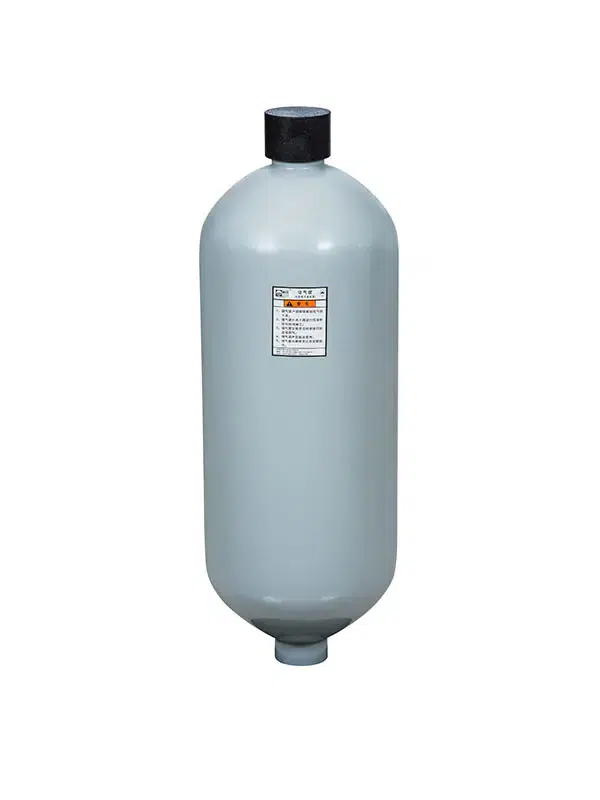

A piston‑type gas‑charged accumulator stores hydraulic energy by compressing nitrogen gas behind a freely‑moving internal piston. One of its biggest strengths is that it can operate at far higher working pressures than standard bladder accumulators.
| Accumulator Type | Maximum Pressure Rating |
|---|---|
| Bladder | 3000 psi (207 bar) |
| Piston (Spring) | 5000 psi (345 bar) |
| Piston (Gas) | 10,000 psi (690 bar) |
Generally speaking, piston‑style units deliver wider operating pressure and temperature ranges, together with much tighter pressure control. These hydro‑pneumatic accumulators are trusted heavy‑duty hydraulic energy‑storage components built for tough‑working industrial environments.
Key Takeaways
- Gas‑charged piston accumulators reach a maximum working pressure up to 10,000 PSI, well beyond the capability of bladder accumulators.
- The piston‑separated structure resists high‑temperature conditions and rapid pressure cycles. Worn seals can be replaced on‑site to cut long‑term maintenance costs.
- Piston accumulators are the preferred choice for high‑cycle and high‑pressure applications, including construction machinery and wind‑power projects.
Piston Type Gas Charge Accumulator: Working Principle

Core Components and Operation
Three major assemblies make up a piston gas‑charge accumulator: cylinder housing, piston assembly and two end caps. The cylinder forms the outer shell of the unit, while the piston slides back and forth freely inside. Specially fitted seals on the piston create two fully‑isolated internal chambers. One chamber is pre‑charged with nitrogen gas, and the oil‑side chamber connects directly to your hydraulic circuit.
Its working cycle is straightforward. Hydraulic fluid flows into the oil chamber through the connection port, pushing the piston toward the nitrogen‑filled chamber. The nitrogen gas gets compressed and hydraulic energy is stored inside the accumulator. When system pressure drops, compressed nitrogen expands and pushes the piston back. Hydraulic oil is then forced out of the accumulator and fed back into the hydraulic system. This energy‑charging and releasing loop repeats thousands of times during regular service.
The piston provides a solid mechanical barrier between gas and hydraulic fluid. This physical separation prevents nitrogen absorption into the oil and delivers consistent performance over long service hours. Well‑fitted seals minimise cross‑chamber leakage. Thanks to this design, piston accumulators handle high‑flow rates and frequent cycling without obvious performance drop‑off.
Advantages Over Bladder Accumulators
The piston design offers several clear advantages over bladder accumulators. First, pressure ratings reach much higher levels. The gas-charged piston can handle up to 10,000 PSI or more. Bladder accumulators typically max out around 3,000 PSI. This higher rating makes piston accumulators suitable for demanding industrial applications where high pressure is a requirement.
Second, the piston type gas charge accumulator tolerates high temperatures and rapid cycling. The metal piston and cylinder handle heat better than the elastomeric bladder in a gas-charged bladder design. The bladder degrades over time from heat and repeated flexing. The piston suffers no such degradation over time. This makes piston accumulators ideal for high-cycle applications that would wear out a bladder quickly.
Third, piston accumulators offer field-repairable construction. Technicians can replace seals and other wear parts without special tools. Bladder accumulators require replacing the entire bladder, which is more complex and costly. The piston design reduces long-term maintenance costs.
The table below compares key performance features across accumulator types:
| Feature | Piston Accumulator | Bladder Accumulator | Diaphragm Accumulator |
|---|---|---|---|
| Energy Storage Capacity | Highest | Moderate | Limited |
| Efficiency | Best over long service life | Lower due to gas absorption | Lower due to gas absorption |
| Compression Ratio | High | Limited by bladder | Limited |
| Suitability | High-flow, high-cycle, high-pressure | Lower-pressure, compact | Low-energy, low-cycle |
| Key Limitation | None significant | Bladder degradation over time | Small gas volume restricts storage |
Piston accumulators generally offer superior energy efficiency compared to bladder and diaphragm types due to their higher flow rates, better response times, and lower energy losses. The piston design creates a clear mechanical separation between gas and fluid, enabling more effective energy transfer while minimizing gas absorption into the hydraulic fluid — a problem that reduces efficiency in other accumulator types.
These hydro-pneumatic accumulators deliver reliable performance in tough conditions. As hydraulic accumulators, they provide essential energy storage for demanding systems. Manufacturers like Chaori Hydraulic produce these accumulators with compact size and sensitive response. These features make the gas-charged piston a preferred choice for precision energy control in systems that require consistent performance day after day.
Applications and Selection of Piston Accumulators

Typical Industrial Applications
Construction and agriculture use piston accumulators the most. Heavy machines like excavators, loaders, and cranes depend on them to store energy and absorb shocks. Large piston accumulators keep working pressure up to 10,000 PSI in big energy jobs. Mobile construction machines and loading stations need high flow rates for safety and efficiency. Farm equipment uses them for smoother, cheaper hydraulic operation in seeding machines.
Wind power systems rely on piston accumulators for key safety tasks. These parts work with pitch cylinders to control blade angle, getting the most power during changing wind speeds. They also store backup power for safe blade feathering during strong winds or power loss. Their higher compression ratio and lower pre-charge loss make them more dependable for these safety roles.
| Feature | Piston Accumulator | Bladder Accumulator |
|---|---|---|
| Maximum flow rate | Up to 818 gpm | Up to 220 gpm |
| Maximum compression ratio | 10:1 or greater | 4:1 |
| Temperature range | -45°F to 320°F | -40°F to 250°F |
| Pre-charge loss (after 1.2 years) | Less than 2 Bar (22 psi) | 9 Bar (130 psi) |
| Failure mode | Gradual (slow gas migration) | Sudden (bladder rupture) |
Marine and offshore gear needs corrosion-resistant versions. Makers offer several protection choices. Water service units have phenolic-coated insides and marine epoxy outsides. Extreme service designs fit offshore drilling and subsea use. All-stainless versions use 304/316-series steel for top corrosion resistance. These versions work well in harsh saltwater settings.
Key Selection Criteria
Engineers must check several things when picking a piston type gas charge accumulator. Operating pressure range comes first. The gas-charged piston handles up to 10,000 PSI, far above bladder limits. Temperature limits matter next. Piston designs run from -45°F to 320°F, covering extreme conditions. Cycling frequency sets durability needs. Piston accumulators shine in high-cycle jobs where bladder accumulators would fail early.
Fluid compatibility affects seal choice. Hydraulic fluids differ in thickness and chemical traits. The accumulator maker must match seals to the specific fluid. Maintenance access also counts. Piston accumulators need regular precharge checks. Technicians can fix them by swapping seals, so keeping spare piston seals is smart. Placing them where easy to reach simplifies service.
Chaori Hydraulic, making parts since 1978, offers piston accumulators that are compact, responsive, and seal well for exact energy control. Their products fit both low- and high-pressure, small-capacity systems. As a supplier with ISO9001, ASME, and CE certifications, they provide wholesale and custom options for many industrial needs. This smart design and production ensures steady performance across tough applications.
The piston type gas charge accumulator is a robust high-pressure energy storage solution. It offers higher pressure limits, precise fluid separation, and field-serviceability. Bladder accumulators cost less for low-pressure jobs, but piston accumulators deliver reliability and efficiency. When designing a system, evaluate duty cycle, pressure spikes, and temperature. If they exceed bladder limits, select an accumulator. Bladder accumulators fail in high-cycle applications. Chaori Hydraulic’s accumulator offers certified reliability.
FAQ
How often should operators check the gas pre-charge?
Manufacturers say to check the pre-charge pressure every six months. If it drops below the set level, the accumulator can’t store as much energy. Checking it regularly stops performance loss and makes the unit last longer.
What maintenance does a piston accumulator require?
The piston seals wear out over time and need to be replaced. Technicians can fix the unit right on site without any special tools. Keeping spare seals available cuts down on downtime.
Can a piston accumulator replace a bladder unit directly?
Engineers need to check mounting dimensions, port sizes, and pressure ratings first. The piston type can handle higher pressures and temperatures. Most systems can make the switch if the specs match the original accumulator.