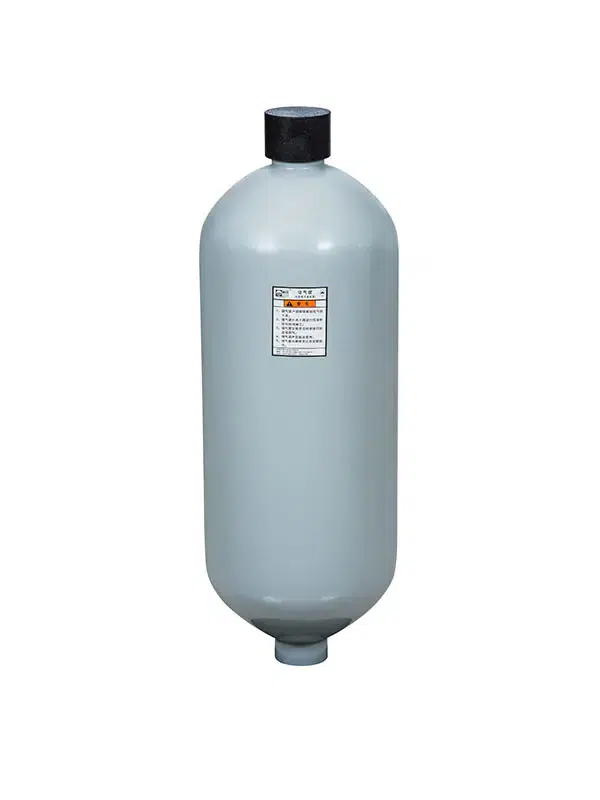
The pressure within a hydraulic accumulator is not static; rather, it depends on the specific system design and operating conditions. In most cases, the critical parameter to focus on is the pre-charge pressure, which is typically set within the range of 60% to 90% of the system’s minimum operating pressure. Within this specific range, the accumulator is able to store sufficient energy while ensuring an effective response whenever system pressure drops.
If the pre-charge pressure is set too high, the accumulator will be unable to absorb an adequate volume of hydraulic fluid, thereby diminishing its energy storage capacity. Conversely, if the pre-charge pressure is set too low, the accumulator risks becoming completely filled with hydraulic fluid, which can damage internal components and compromise overall system efficiency.
In practical applications, the specific PSI (pounds per square inch) setting should be fine-tuned based on various factors, including load fluctuations, required response speeds, and the system’s operating pressure range. For this reason, Chaori strongly recommends that you exercise meticulous care when setting and verifying the pre-charge pressure during both installation and maintenance procedures.
Key Takeaways
- Set the pre-charge pressure between 3000 and 5000 psi. This facilitates the proper functioning of the hydraulic system and ensures safety.
- Always adhere to the manufacturer’s instructions regarding pre-charge pressure settings. Different types of accumulators require specific pre-charge pressure settings to operate correctly.
- Use dry nitrogen for pre-charging. Never use oxygen or compressed air; these gases may trigger chemical reactions and damage the system.
- Regularly check the pre-charge pressure, particularly after installation. Perform a follow-up check within the first week of operation. This helps ensure the safe and reliable operation of the system.
- Adjust the pre-charge pressure according to operational requirements. For energy storage applications, set it to 90% of the minimum operating pressure. For shock absorption applications, set it close to the system’s maximum pressure.
Recommended PSI for Hydraulic Accumulators
Typical PSI Ranges
Understanding the correct pressure for a hydraulic accumulator is crucial. Most accumulators perform optimally within a pressure range of 3,000 to 5,000 psi. This corresponds to approximately 207 to 350 bar. Many types of machinery utilize this specific pressure range. Never set the pressure based on guesswork; instead, follow a few simple guidelines when establishing the pre-charge pressure.
Set the pre-charge pressure to approximately one-third of the system’s operating pressure. Ensure that this value is at least 1,000 psi and never falls below 25% of the system’s operating pressure.
Another guideline is to set the pre-charge pressure to half of the system’s minimum operating pressure. Adopting this approach helps extend the service life of the valve seats while also preventing premature wear on the accumulator itself.
It is imperative to regularly check for—and address—any instances of excessively low pre-charge pressure. If the pre-charge pressure drops too low, the accumulator will fail to function correctly, which can subsequently lead to malfunctions within the hydraulic system.
Adhering to these guidelines helps ensure the safe operation of your system and keeps it in optimal working condition. If you choose Chaori’s piston-type accumulator stations and nitrogen cylinder banks, you gain the flexibility to set the pressure according to your specific requirements. This means you can tailor the pre-charge pressure to suit different types of machinery or specific operational tasks. Chaori’s design solutions enable you to effectively manage pressure fluctuations, thereby safeguarding the safe and reliable operation of your equipment.
Tip: Always use a pressure gauge to verify the pre-charge pressure before starting up the system.
Manufacturer and System Specs
The manufacturer has provided clear steps for setting the pre-charge pressure; it is imperative that you strictly adhere to these instructions at all times. The type of accumulator and its specific function will determine the appropriate pressure value. The following table illustrates these differences:
| Accumulator Type | Recommended Precharge Pressure |
|---|---|
| Bladder | 80% of minimum hydraulic system pressure |
| Piston | 100 psi below minimum system pressure |
If you are applying accumulators in fields such as braking systems, you may need to set the pre-charge pressure slightly differently. For instance, the pre-charge pressure for bladder-type accumulators should be set to 80% of the minimum safe pressure, whereas for piston-type accumulators, it should be set to 100 psi below the minimum safe pressure.
Thanks to new technologies, you can maintain the correct pre-charge pressure more effectively. Some systems utilize sensors to monitor pressure in real time; these sensors trigger an alarm whenever the pressure drops too low or rises too high. This enables you to take timely corrective action to resolve issues before a malfunction causes equipment damage or leads to downtime.
Asahi’s piston accumulator stations and nitrogen cylinder banks provide you with specialized tools for setting and monitoring pre-charge pressure. You can adjust pressure parameters to suit the specific requirements of your system, thereby ensuring smooth overall operation. This not only enhances the safety of your hydraulic equipment but also helps to extend its service life.
Setting the Right Accumulator PSI
Check System Pressure
First, you need to understand the system’s pressure limits. Please consult the minimum and maximum operating pressures involved in your hydraulic system. These values will assist you in selecting the appropriate accumulator pressure. It is essential to use a pressure gauge to monitor the pressure; skipping this step could result in an incorrect setting of the pre-charge pressure.
- Determine the minimum pressure value required for the system to function properly.
- Record the maximum pressure value that the system can withstand.
- Ensure that your accumulator’s operating range falls between these two values.
Consider how the accumulator interacts with other components within the system. The accumulator must be capable of delivering sufficient fluid pressure when required, while simultaneously safely storing energy during non-operational periods.
Tip: Before performing the accumulator pre-charging procedure, always check the system’s current pressure. Doing so helps prevent equipment damage caused by operational errors.
Pre-Charge Pressure Guidelines
Setting the correct pre-charge pressure is crucial for ensuring safety and achieving optimal performance. The pre-charge pressure must always be lower than the system’s maximum operating pressure. If the pre-charge pressure is set too high, the accumulator will be unable to take in sufficient fluid; if set too low, it will be unable to store sufficient energy.
Please follow the steps below to set the pre-charge pressure:
- Find the lowest system pressure.
- For bladder accumulators, set the pre-charge at 80% of the lowest system pressure.
- For piston accumulators, set the pre-charge 100 psi below the lowest system pressure.
- Only use dry nitrogen gas for pre-charging. Never use oxygen or compressed air.
- Fill the gas side slowly and check the pressure with a gauge.
- Add hydraulic fluid to the fluid side at a pressure higher than the pre-charge.
Setting the appropriate pre-charge pressure helps extend the service life of the accumulator and enhance its operational performance. Neglecting this step may lead to damage to the bladder or piston, thereby reducing the overall operational efficiency of the system. It is imperative to strictly adhere to the relevant guidelines provided by the accumulator manufacturer. If you are utilizing an Asahi piston-type accumulator station, you have the flexibility to adjust the pre-charge pressure to suit the specific requirements of your system.
| Parameter | Relationship |
|---|---|
| Pre-charge Pressure (P0) | Should be ≤ 90% of Minimum System Pressure (P1) |
| Maximum System Pressure (P2) | Should not be more than 4 times Pre-charge Pressure (P0) |
Note: The pre-charge pressure must never exceed the minimum safe pressure. This helps ensure the safe operation and proper working condition of the hydraulic system.
Application-Specific Adjustments
Different operating conditions require the setting of different pre-charge pressures. If the objective is to store a greater amount of energy, the pre-charge pressure should be set to 90% of the minimum operating pressure; conversely, if the goal is to absorb shock, the pre-charge pressure should be set closer to the system’s maximum pressure. Furthermore, it is essential to account for temperature variations, as temperature fluctuations will result in changes to the internal pressure of the accumulator.
| Factor | Recommendation |
|---|---|
| Pre-charge Pressure | Set at 80-90% of lowest system pressure for enough gas volume. |
| Temperature Effects | Watch for temperature changes that can change pressure and volume. |
| Safety Factors | Pick an accumulator 10-20% bigger than you need for extra safety. |
If you use Chaori’s solutions, you can change the pre-charge and volume for your job. This helps you get the best results from your hydraulic system.
Remember: The right pre-charge is important for safe, efficient, and long-lasting hydraulic equipment.
Factors Affecting Accumulator PSI
System and Load Demands
Before setting the pre-charge pressure, you must carefully consider your hydraulic system and its specific load conditions. A hydraulic accumulator stores fluid pressure, serving as a ready source of backup power for the system. It releases energy instantaneously to sustain system operation whenever the hydraulic pump stops running or the system is subjected to sudden shock loads. You must identify the minimum and maximum operating pressure values encountered during the system’s actual operation. These figures serve as critical benchmarks to guide you in selecting the appropriate pre-charge pressure. If the pre-charge pressure is set too low, the accumulator will be unable to perform its intended function effectively; conversely, if set too high, it may lead to damage to system components. Generally speaking, setting the pre-charge pressure slightly lower is safer than setting it too high. It is important to note that if a diaphragm-type (or bladder-type) accumulator is operated with absolutely no pre-charge pressure, its internal diaphragm (or bladder) may rupture, thereby compromising the performance of the entire system.
- How much energy do you need to store?
- What magnitude of shock load must the system be able to withstand?
- What are the minimum and maximum operating pressures during system operation?
- What are the potential risks associated with pre-charge pressure being set too low or too high?
Chaori products allow you to flexibly adjust pressure and volume parameters to suit the specific requirements of your hydraulic system. You can set the pre-charge pressure to the value that best aligns with your application needs, thereby ensuring the safe and stable operation of your equipment.
Accumulator Type and Size
The type and specifications of an accumulator determine how its pre-charge pressure is set. Bladder-type accumulators typically require the pre-charge pressure to be set at 90% of the minimum operating pressure; piston-type accumulators, conversely, achieve optimal performance when their pre-charge pressure is set 100 psi below the minimum operating pressure. It is essential to select an accumulator with appropriate specifications to ensure it can store sufficient fluid pressure. If the accumulator is undersized, it will be unable to store adequate energy; if it is oversized, it will result in a waste of both space and capital. Please be sure to strictly adhere to the relevant instructions provided by the manufacturer. Chaori offers a wide range of accumulator types and specifications, perfectly tailored to meet the specific requirements of your hydraulic system.
| Accumulator Type | Pre-charge Setting |
|---|---|
| Bladder | 90% of minimum working pressure |
| Piston | 100 psi below minimum pressure |
Temperature and Safety Margins
Temperature fluctuations can affect an accumulator’s pre-charge pressure. Cold weather may result in a 10% to 15% reduction in volume, while hot weather can cause the pressure to rise beyond your expectations. Therefore, it is essential to perform temperature corrections to ensure safe system operation. We recommend always selecting an accumulator with a capacity 10% to 20% larger than your actual requirements; this provides a buffer that allows you to effectively accommodate fluctuations in temperature and pressure. Chaori hydraulic accumulators feature adjustable pre-charge pressure and volume, enabling them to adapt to the specific demands of various operating environments.
Tip: Be sure to regularly check the accumulator’s pre-charge pressure, particularly when the system is operating in high- or low-temperature environments.
Checking and Adjusting Accumulator PSI
Tools and Steps
You need special tools to check the pre-charge. Use a nitrogen hydraulic accumulator pressure test tool. This tool fits most accumulators with a standard schrader valve. You also need a nitrogen gas source. Get a pressure gauge and fittings with bleed valves.
Here are the steps to measure and adjust the pre-charge:
- Make sure the system is at the right temperature. Check that all moving parts are safe.
- Turn off the hydraulic system. Drain all fluid pressure.
- Connect the testing valve to the nitrogen tank. Keep all valves closed first.
- Find out the pre-charge pressure you need.
- Take off the safety caps from the accumulator and nitrogen tank.
- Open the charging fill valve. Let nitrogen gas go into the accumulator.
- Slowly open the nitrogen tank valve. Watch the pressure gauge.
- When you reach the right pre-charge, close all valves.
- Open the bleed valve. Let out any trapped gas.
- Disconnect the charge kit. Put the safety caps back on.
Tip: Always check that all valves are closed before removing the accumulator.
Common Mistakes to Avoid
A common error people make when checking or adjusting pre-charge pressure is setting it either too high or too low. If the pre-charge pressure is set incorrectly, it can trigger hydraulic shock or lead to leaks; it may even cause damage to the accumulator itself. Some individuals forget to depressurize the system beforehand—a practice that is extremely dangerous. Others attempt to operate valves without first inspecting the accumulator, which can result in the accumulator releasing its stored energy rapidly and instantaneously.
If you use the wrong pressure gauge, or install it in the wrong location, you may be misled into believing that no pressure exists within the system, when in reality, pressure may still be present. Such oversights can very easily lead to safety accidents. Therefore, it is imperative to always use the correct tools and to strictly adhere to the established sequence of procedures.
| Inspection Interval | Action |
|---|---|
| First Installation | Check pre-charge pressure |
| First Week of Operation | Check at least once daily |
| After First Week | If stable, check weekly |
| Established Systems | Check every three to six months |
Safety Precautions
When operating a hydraulic accumulator, you must strictly adhere to all safety protocols. It is mandatory to wear safety goggles and gloves at all times. Before initiating the charging process, you must first identify and eliminate all potential leak points. Please perform these operations in a well-ventilated area to prevent the inhalation of gases. Never attempt to pre-charge the accumulator while the system is under pressure; the system must be fully depressurized before undertaking such operations. Utilize isolation valves and drain the fluid from the system prior to commencing work.
Note: Overcharging the accumulator can result in damage to the unit, whereas undercharging can lead to abnormal fluid pressure and subsequent system instability. Therefore, it is imperative to set the charging pressure to the lowest value within the safe operating range.
By strictly adhering to the aforementioned operating procedures and safety guidelines, you can ensure the smooth and efficient operation of your hydraulic system while simultaneously safeguarding your personal safety against potential hazards.
FAQ
What gas should you use to pre-charge a hydraulic accumulator?
You should always use dry nitrogen gas. Never use oxygen or compressed air. Nitrogen is safe and does not react with hydraulic oil.
How often should you check accumulator PSI?
Check the pre-charge at installation, daily for the first week, then weekly. For stable systems, check every three to six months.
What happens if you set the pre-charge too high?
If you set the pre-charge too high, the accumulator cannot store enough fluid. This can cause poor system performance and may damage equipment.
Can you adjust the pre-charge for different applications?
Yes, you can adjust the pre-charge to match your system’s needs. Chaori’s Piston Accumulator Station lets you set custom pressures for different jobs.